Guardian of the Digital Footprint: Instagram Sharenting Protection Feature - 2023
Mitigating Digital Privacy & Deepfake
Risks on Social Media
AI-Integrated Posting Flow Elevated Parental Privacy Awareness and Protected Children's
Online Identities Against Generative AI Threats
My Role
UX/UI Designer & Researcher
Mixed-Methods Research, Interaction Design, Affinity Mapping, Brainstorming, Information Architecture, Prototyping, Usability Testing
Team
Me (UX/UI Designer & Researcher)
1 UX Researcher
1 Visual Designer
1 Notetaker
Overview
I led the end-to-end design of a social computing feature integrated directly into Instagram's image posting flow.
By utilizing artificial intelligence to proactively detect sensitive child data and deepfake vulnerabilities, we empowered parents to share safely while preserving their children's digital footprint.
Timeline
26 Weeks
✨
HIGHLIGHTS
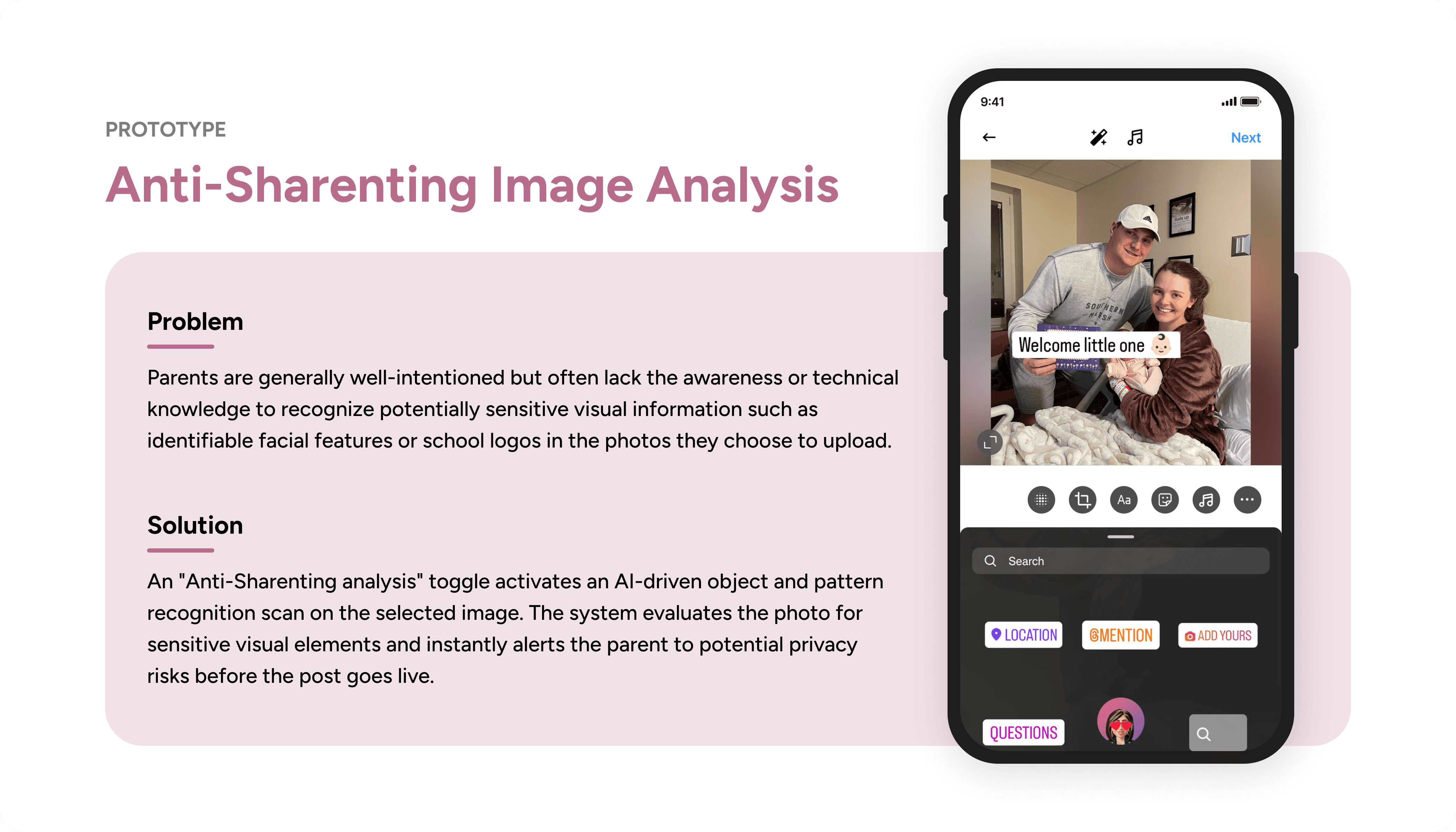
Transforming how parents share memories by integrating proactive risk detection, deepfake prevention, and intuitive privacy controls directly into Instagram


✨
CONTEXT
When sharing memories unintentionally exposes
children to long-term AI risks A modern struggle between parental pride and child privacy
A modern struggle between parental
pride and child privacy
In the digital age, parents frequently document their children's milestones on social media a practice known as Sharenting (Sharing + Parenting).
A 2021 study found that 95% of parents with young children share photos online, totaling over 90 million photos daily. While done to celebrate achievements and connect with family, it often occurs without the child's consent and leaves a lasting, vulnerable digital footprint.
With the rise of generative AI, this innocent practice has become a massive security flaw. Anyone with a smartphone can now steal a child's image and reuse it to create hyper-realistic, digitally altered deepfakes without any technical skills.
✨
PROBLEM
Is it safe to post this picture of my child?
A well-intentioned practice exposing a massive privacy and safety flaw
What seems like harmless sharing exposes children to severe, long-term risks. Barclays Bank predicts that by 2030, parents sharing about their kids online will account for two-thirds of identity fraud cases, translating to 7.4 million identity fraud cases annually.
Australian e-Safety investigators suggest up to 50% of pedophilic images on websites can be traced back to parents' social media accounts.
The chilling reality was illustrated in the "A Message from Ella" campaign, demonstrating how innocent social media pictures can be weaponized to construct a digital adult version of a child. This stolen data can be used to copy a child's voice to scam parents for money, orchestrate identity theft, or humiliate them with memes.
Children face risks of:
Identity Theft

Emotional Distress

Cyberbullying

✨
THE PROBLEM STATEMENT
How might we develop a social computing product that empowers parents to make informed decisions about the information they share about their children online, mitigating the severe risks of identity theft and deepfake exploitation, without entirely limiting their ability to post memories?
✨
WHY RESEARCH?
Before solutions, we asked better questions
Children prioritize privacy while
parents seek connection
We needed to understand the behavioral disconnect between parental intentions and privacy risks, and why current social platforms fail to protect children's digital footprints.
We used a mixed-methods approach to turn assumptions into evidence, alongside an analysis of media highlighting the deepfake threat:
The Consent Disconnect :
The video "Why Kids Are Confronting Their Parents About 'Sharenting' | NYT Opinion" perfectly captured the core friction: parents share to connect with extended family like grandparents, but children feel a deep loss of autonomy. When a mother asked what was wrong with a cute photo, the child simply responded, "Yeah because you didn't ask".
The Weaponization of Images :
Most parents are cautious but lack the technical knowledge to identify hidden metadata or visual risks. Experts in "The rise of deepfakes and how to stop them | FT Film" note that the speed, scale, and commercialization of AI fakery have made everyday social media images enormously threatening.
Quantitative Survey & Interviews:
Gathered responses and conducted interviews with 35 children and 15 parents.
Secondary Research:
Reviewed data on identity fraud and pedophilic image sourcing related to social media.
Affinity Mapping:
Synthesized qualitative data to categorize user pain points into distinct themes, such as Parent Knowledge Over Sharenting, Security Concerns, Cyber Bullying, and Identity Thefts.
Affinity Mapping

✨
WHY RESEARCH?
Most parents are cautious but lack the
technical knowledge to identify risks
Understanding where the disconnect happens
Our research revealed that the root of the problem wasn't malicious intent, but a systemic tension between parental connection and child privacy.
Blind Decisions:
Parents share to build relationships and show parental pride, but do not know how to spot hidden metadata or visual risks.
Anxiety with Digital Footprints:
Children expressed deep anxiety over their future reputation and lack of consent. One child noted, "People got to know things about me that I wanted confidential... it made me uncomfortable as people judged me".
✨
RESEARCH TAKEAWAY
These insights shaped our 3 core design principles:
Proactive Risk Detection
Contextual Education
Empowered Parental Control
✨
DESIGN & ITERATION
Rapid Prototyping and Feature Prioritization
Prioritization of Key Features
Working as a team, we conducted extensive brainstorming sessions, generating ideas ranging from age-based defaults to AI photo analysis.
Through collaborative dot-voting and feature prioritization, we evaluated technical feasibility and zeroed in on an AI intervention.
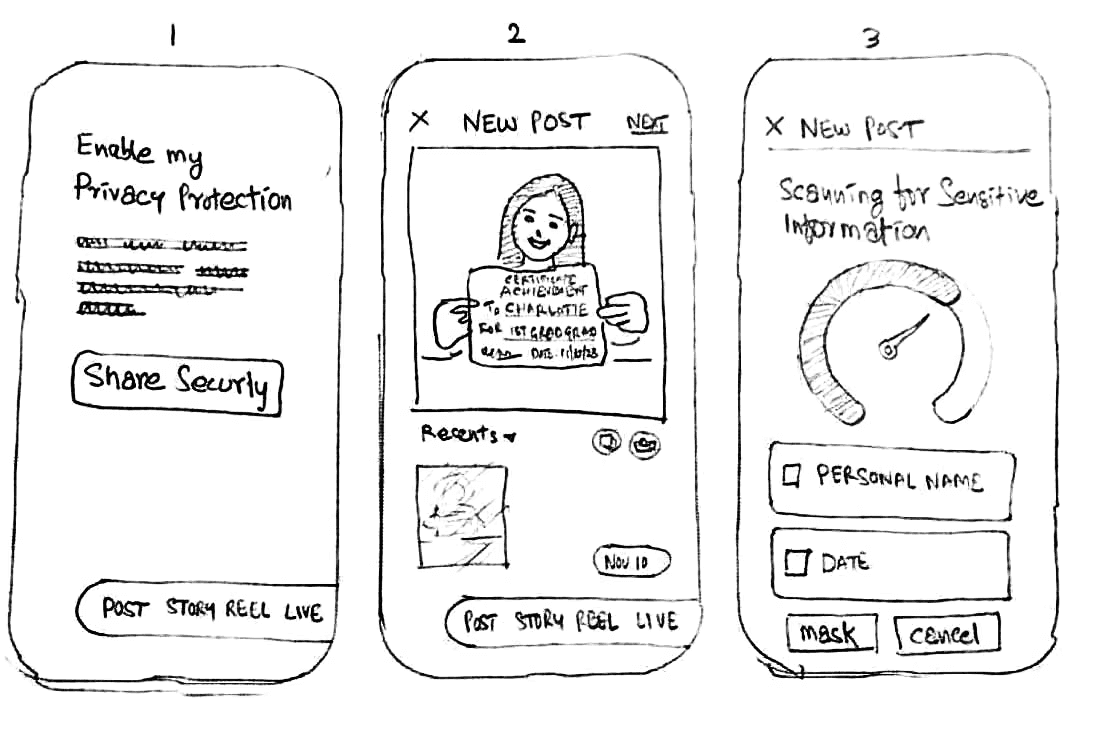
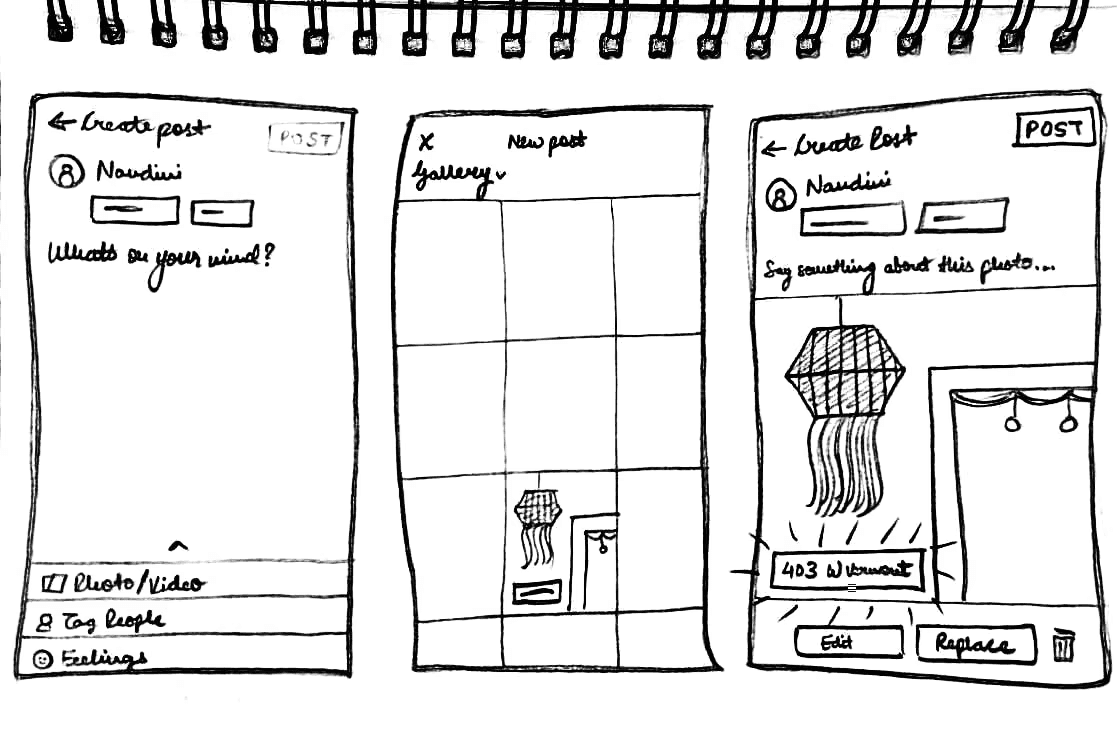
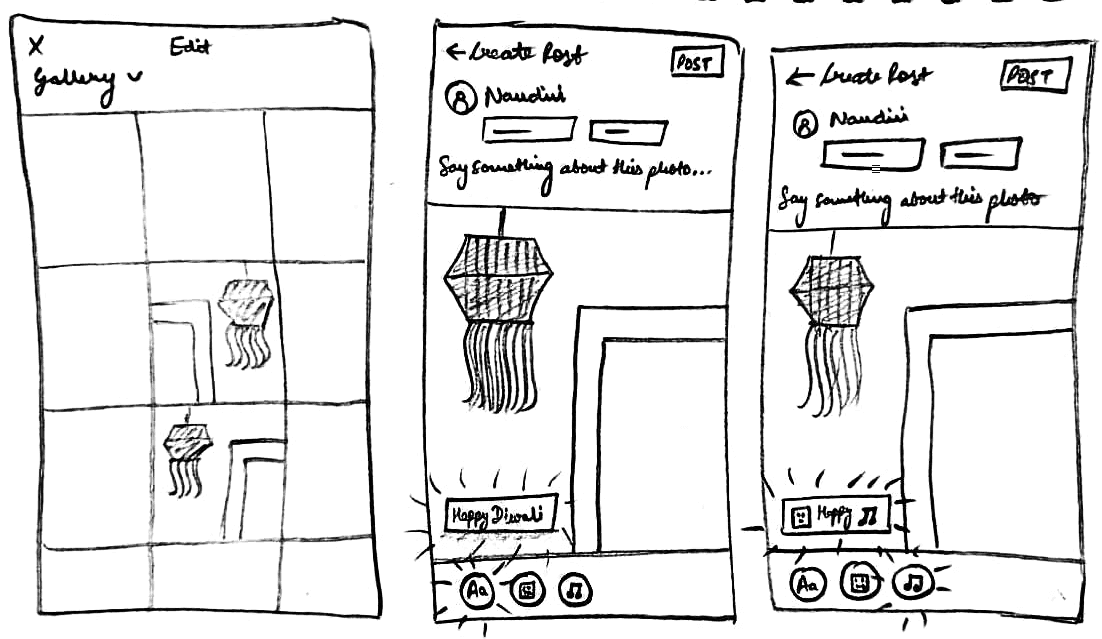
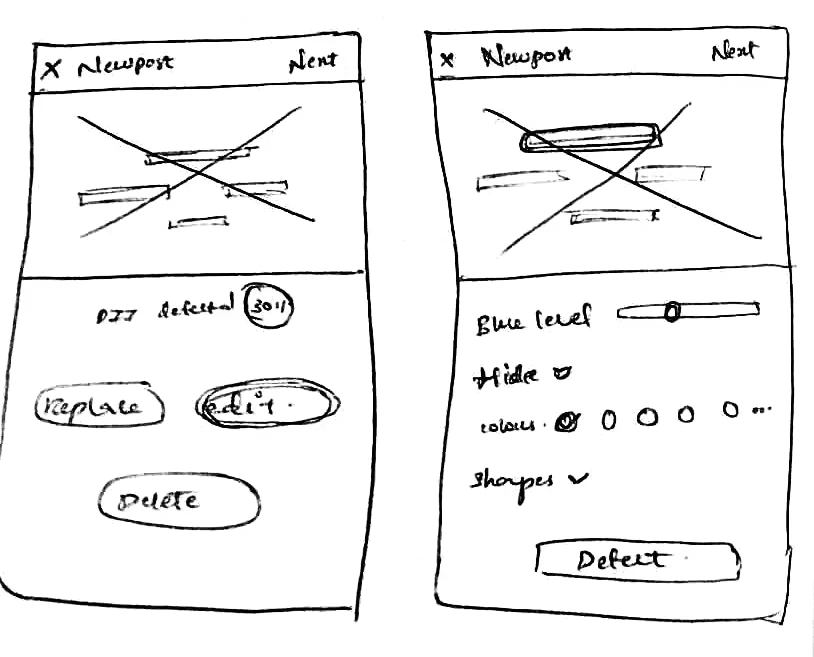
We defined the Information Architecture to ensure the flow felt like a natural extension of Instagram, and prioritized rough sketches and paper prototypes to quickly validate concepts.
AI-Driven Image Analysis:
Designed a scanning flow using object recognition to detect faces and locations, offering options to Edit (blur/pixelate), Replace, or Delete.
Contextual Metadata Analysis:
Mapped a flow using NLP to scan captions/geotags, suggesting safer wording or restricting audience visibility to "Close Friends".
Sharental Dashboard:
Grouped privacy insights into a dedicated hub with anti-screenshot toggles.
Information Architecture

Rough Sketches and Paper Prototypes


✨
DESIGN TECHNICAL ROADBLOCK / CHALLENGES
Balancing intervention with user friction
Learning from learnability and trust constraints
During early prototyping of the AI risk detection, we designed generic "Sensitive Info Found" alerts.
However, testing revealed a major roadblock: users struggled with the "learnability" of the feature and lacked trust in the AI's recommendations.
The Pivot on Explanations:
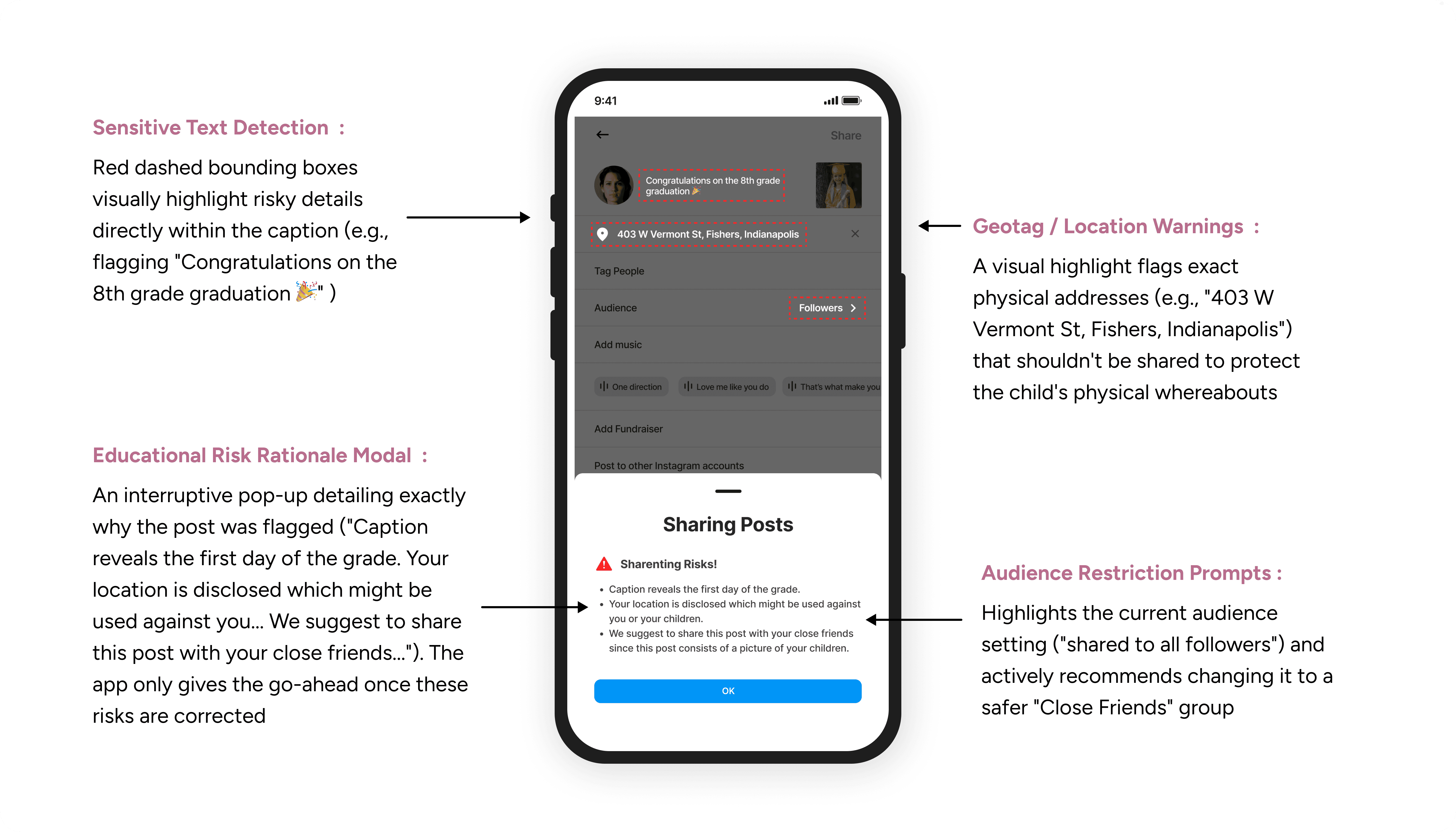
Users needed deeper contextual explanations as to why a specific image was flagged as a risk, rather than just generic alerts. We adapted by planning to provide detailed, educational rationale alongside every system privacy recommendation.
✨
KEY TAKEAWAY
This experience reinforced the critical importance
of building trust through transparency when designing
AI interventions for sensitive user data
✨
FROM FIRST DRAFT TO FINAL DESIGN
After addressing learnability constraints, we evolved the interface into a validated flow
ANTI-SHARENTING IMAGE ANALYSIS

IMAGE EDITING ( MASKING / BLURRING )

IMAGE REPLACEMENT / DETECTION

CONTEXTUAL METADATA ANALYSIS
SHARENTAL DASHBOARD

✨
USABILITY TESTING
Testing the Experience Before Perfecting It
Pilot first, data next, insights always
We conducted rigorous testing using Cognitive Walkthroughs, Expert Evaluations with 10 HCI professionals, and moderated Think-Aloud usability testing with 5 parent participants.
Quantitative Metrics & Qualitative Feedback:
Users found the interface intuitive and reported that the feature significantly heightened their privacy awareness, successfully impacting how they crafted captions and managed tags. Parents appreciated the tool's potential to support informed decision-making without completely restricting their ability to share.
✨
LEARNINGS FROM USABILITY TESTING
Testing revealed friction points that we immediately documented for future iterations
Observe first, adapt fast and refine
Testing revealed friction points that we immediately documented for future iterations
Hidden Activation Controls
Before:
The toggle button required to activate the Sharenting Protection feature was not prominent enough and was easily missed by users.
After:
Recommended making the opt-in process highly discoverable and developing a comprehensive onboarding flow for first-time users.
Confusing Manual Tools
Before:
Participants found the manual masking, blurring, and pixelation tools confusing to use.
After:
Recommended clearer instructions and expanded editing toolkits including automatic facial recognition redaction.
✨
USABILITY TESTING TURNED GUESSES INTO REAL INSIGHTS
Participants reported the feature significantly
increased their privacy awareness, proving the design
successfully empowered responsible sharing
without limiting parental pride
✨
LEARNINGS
Reflecting, Learning, and Growing Through Every Project
Learning from privacy and AI design
Transparency Builds Trust:
Users will not adopt AI recommendations blindly; providing detailed, educational rationale is essential for feature learnability and user trust.
Integration over Invention:
By embedding the Sharenting Protection directly into the existing Instagram posting flow, we reduced friction and ensured the intervention met parents where they already were.
Balancing Empathy with Security:
A successful social computing product must respect the parent's desire for connection while firmly protecting the child's right to privacy and a secure digital footprint.

Back to Top
✨
Featured Projects
Where impactful storytelling meets immaculate UX



Hi
Your next UX designer is one email away 😇
I’m currently open for full time roles and collaborations where I can bring user-centered magic to the table ✨
Made with 💖 and 🍵 by Nandini © 2026
Guardian of the Digital Footprint: Instagram Sharenting Protection Feature - 2023
Mitigating Digital Privacy & Deepfake
Risks on Social Media
AI-Integrated Posting Flow Elevated Parental Privacy Awareness and Protected Children's
Online Identities Against Generative AI Threats
My Role
UX/UI Designer & Researcher
Mixed-Methods Research, Interaction Design, Affinity Mapping, Brainstorming, Information Architecture, Prototyping, Usability Testing
Team
Me (UX/UI Designer & Researcher)
1 UX Researcher
1 Visual Designer
1 Notetaker
Overview
I led the end-to-end design of a social computing feature integrated directly into Instagram's image posting flow.
By utilizing artificial intelligence to proactively detect sensitive child data and deepfake vulnerabilities, we empowered parents to share safely while preserving their children's digital footprint.
Timeline
26 Weeks
✨
HIGHLIGHTS
Transforming how parents share memories by integrating proactive risk detection, deepfake prevention, and intuitive privacy controls directly into Instagram
✨
CONTEXT
When sharing memories unintentionally exposes
children to long-term AI risks A modern struggle between parental pride and child privacy
A modern struggle between parental
pride and child privacy
In the digital age, parents frequently document their children's milestones on social media a practice known as Sharenting (Sharing + Parenting).
A 2021 study found that 95% of parents with young children share photos online, totaling over 90 million photos daily. While done to celebrate achievements and connect with family, it often occurs without the child's consent and leaves a lasting, vulnerable digital footprint.
With the rise of generative AI, this innocent practice has become a massive security flaw. Anyone with a smartphone can now steal a child's image and reuse it to create hyper-realistic, digitally altered deepfakes without any technical skills.
✨
PROBLEM
Is it safe to post this picture of my child?
A well-intentioned practice exposing a massive privacy and safety flaw
What seems like harmless sharing exposes children to severe, long-term risks. Barclays Bank predicts that by 2030, parents sharing about their kids online will account for two-thirds of identity fraud cases, translating to 7.4 million identity fraud cases annually.
Australian e-Safety investigators suggest up to 50% of pedophilic images on websites can be traced back to parents' social media accounts.
The chilling reality was illustrated in the "A Message from Ella" campaign, demonstrating how innocent social media pictures can be weaponized to construct a digital adult version of a child. This stolen data can be used to copy a child's voice to scam parents for money, orchestrate identity theft, or humiliate them with memes.
Children face risks of:
Identity Theft
Emotional Distress
Cyberbullying
✨
THE PROBLEM STATEMENT
How might we develop a social computing product that empowers parents to make informed decisions about the information they share about their children online, mitigating the severe risks of identity theft and deepfake exploitation, without entirely limiting their ability to post memories?
✨
WHY RESEARCH?
Before solutions, we asked better questions
Children prioritize privacy while
parents seek connection
We needed to understand the behavioral disconnect between parental intentions and privacy risks, and why current social platforms fail to protect children's digital footprints.
We used a mixed-methods approach to turn assumptions into evidence, alongside an analysis of media highlighting the deepfake threat:
The Consent Disconnect :
The video "Why Kids Are Confronting Their Parents About 'Sharenting' | NYT Opinion" perfectly captured the core friction: parents share to connect with extended family like grandparents, but children feel a deep loss of autonomy. When a mother asked what was wrong with a cute photo, the child simply responded, "Yeah because you didn't ask".
The Weaponization of Images :
Most parents are cautious but lack the technical knowledge to identify hidden metadata or visual risks. Experts in "The rise of deepfakes and how to stop them | FT Film" note that the speed, scale, and commercialization of AI fakery have made everyday social media images enormously threatening.
Quantitative Survey & Interviews:
Gathered responses and conducted interviews with 35 children and 15 parents.
Secondary Research:
Reviewed data on identity fraud and pedophilic image sourcing related to social media.
Affinity Mapping:
Synthesized qualitative data to categorize user pain points into distinct themes, such as Parent Knowledge Over Sharenting, Security Concerns, Cyber Bullying, and Identity Thefts.
Affinity Mapping
✨
WHY RESEARCH?
Most parents are cautious but lack the
technical knowledge to identify risks
Understanding where the disconnect happens
Our research revealed that the root of the problem wasn't malicious intent, but a systemic tension between parental connection and child privacy.
Blind Decisions:
Parents share to build relationships and show parental pride, but do not know how to spot hidden metadata or visual risks.
Anxiety with Digital Footprints:
Children expressed deep anxiety over their future reputation and lack of consent. One child noted, "People got to know things about me that I wanted confidential... it made me uncomfortable as people judged me".
✨
RESEARCH TAKEAWAY
These insights shaped our 3 core design principles:
Proactive Risk Detection
Contextual Education
Empowered Parental Control
✨
DESIGN & ITERATION
Rapid Prototyping and Feature Prioritization
Prioritization of Key Features
Working as a team, we conducted extensive brainstorming sessions, generating ideas ranging from age-based defaults to AI photo analysis.
Through collaborative dot-voting and feature prioritization, we evaluated technical feasibility and zeroed in on an AI intervention.
We defined the Information Architecture to ensure the flow felt like a natural extension of Instagram, and prioritized rough sketches and paper prototypes to quickly validate concepts.
AI-Driven Image Analysis:
Designed a scanning flow using object recognition to detect faces and locations, offering options to Edit (blur/pixelate), Replace, or Delete.
Contextual Metadata Analysis:
Mapped a flow using NLP to scan captions/geotags, suggesting safer wording or restricting audience visibility to "Close Friends".
Sharental Dashboard:
Grouped privacy insights into a dedicated hub with anti-screenshot toggles.
Information Architecture
Rough Sketches and Paper Prototypes
✨
DESIGN TECHNICAL ROADBLOCK / CHALLENGES
Balancing intervention with user friction
Learning from learnability and trust constraints
During early prototyping of the AI risk detection, we designed generic "Sensitive Info Found" alerts.
However, testing revealed a major roadblock: users struggled with the "learnability" of the feature and lacked trust in the AI's recommendations.
The Pivot on Explanations:
Users needed deeper contextual explanations as to why a specific image was flagged as a risk, rather than just generic alerts. We adapted by planning to provide detailed, educational rationale alongside every system privacy recommendation.
✨
KEY TAKEAWAY
This experience reinforced the critical importance
of building trust through transparency when designing
AI interventions for sensitive user data
✨
FROM FIRST DRAFT TO FINAL DESIGN
After addressing learnability constraints, we evolved the interface into a validated flow
ANTI-SHARENTING IMAGE ANALYSIS
IMAGE EDITING ( MASKING / BLURRING )
IMAGE REPLACEMENT / DETECTION
CONTEXTUAL METADATA ANALYSIS
SHARENTAL DASHBOARD
✨
USABILITY TESTING
Testing the Experience Before Perfecting It
Pilot first, data next, insights always
We conducted rigorous testing using Cognitive Walkthroughs, Expert Evaluations with 10 HCI professionals, and moderated Think-Aloud usability testing with 5 parent participants.
Quantitative Metrics & Qualitative Feedback:
Users found the interface intuitive and reported that the feature significantly heightened their privacy awareness, successfully impacting how they crafted captions and managed tags. Parents appreciated the tool's potential to support informed decision-making without completely restricting their ability to share.
✨
LEARNINGS FROM USABILITY TESTING
Testing revealed friction points that we immediately documented for future iterations
Observe first, adapt fast and refine
Testing revealed friction points that we immediately documented for future iterations
Hidden Activation Controls
Before:
The toggle button required to activate the Sharenting Protection feature was not prominent enough and was easily missed by users.
After:
Recommended making the opt-in process highly discoverable and developing a comprehensive onboarding flow for first-time users.
Confusing Manual Tools
Before:
Participants found the manual masking, blurring, and pixelation tools confusing to use.
After:
Recommended clearer instructions and expanded editing toolkits including automatic facial recognition redaction.
✨
USABILITY TESTING TURNED GUESSES INTO REAL INSIGHTS
Participants reported the feature significantly
increased their privacy awareness, proving the design
successfully empowered responsible sharing
without limiting parental pride
✨
LEARNINGS
Reflecting, Learning, and Growing Through Every Project
Learning from privacy and AI design
Transparency Builds Trust:
Users will not adopt AI recommendations blindly; providing detailed, educational rationale is essential for feature learnability and user trust.
Integration over Invention:
By embedding the Sharenting Protection directly into the existing Instagram posting flow, we reduced friction and ensured the intervention met parents where they already were.
Balancing Empathy with Security:
A successful social computing product must respect the parent's desire for connection while firmly protecting the child's right to privacy and a secure digital footprint.
Back to Top
✨
Featured Projects
Where impactful storytelling meets immaculate UX
Hi
Your next UX designer is one email away 😇
I’m currently open for full time roles and collaborations where I can bring user-centered magic to the table ✨
Made with 💖 and 🍵 by Nandini © 2026